What won't leave you alone?
Whatever state it is in is fine. Let's go. What are we reaching for?
Let the work tell you what that something is.
Iteration, conversation, course-correction. Every act is discovery. Sometimes technical: What is the pipeline? Sometimes creative; what is our visual language. Often (so far always) it's both at the same time. We the work as it reveals.
Something gets across that you couldn't say any other way.
A piece works when it carries something the artist couldn't carry alone. An experience that lives in someone else's head once they've seen it. That transmission is the whole point.
MAKE
What won't leave you alone?
Whatever state it is in is fine. Let's go. What are we reaching for?
SOMETHING
Let the work tell you what that something is.
Iteration, conversation, course-correction. Every act is discovery. Sometimes technical: What is the pipeline? Sometimes creative; what is our visual language. Often (so far always) it's both at the same time. We the work as it reveals.
BEAUTIFUL
Something gets across that you couldn't say any other way.
A piece works when it carries something the artist couldn't carry alone. An experience that lives in someone else's head once they've seen it. That transmission is the whole point.
Source material — Jonathan's book
The Trinary Matrix
Jonathan Arons
Artist-led, start to finish.
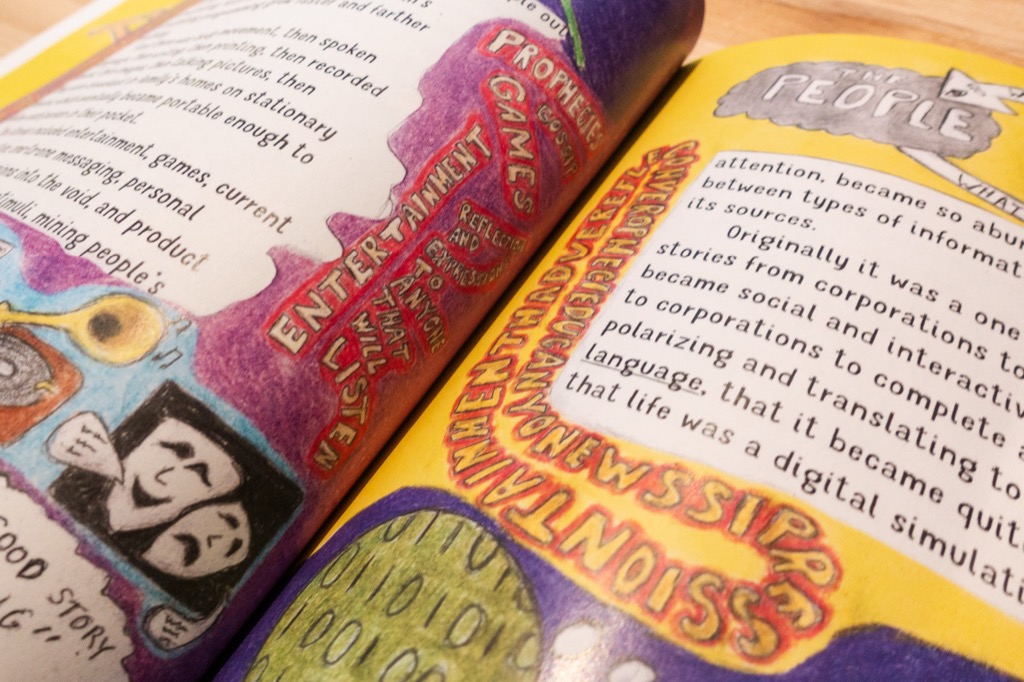
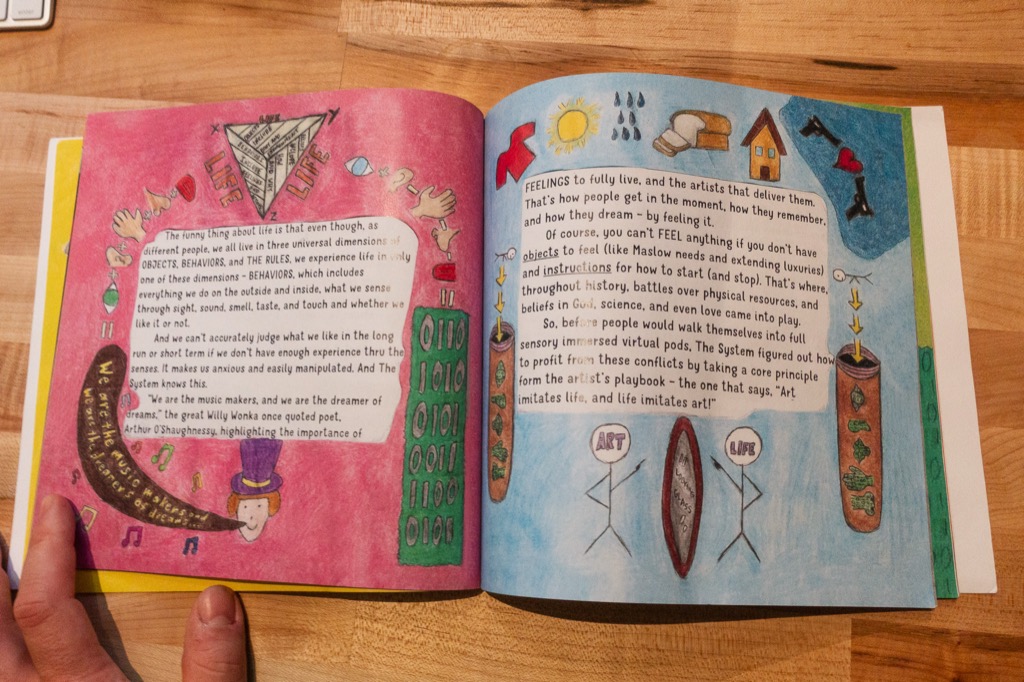
Jonathan came in with a finished book. His own illustrations, his own story, all of it already on the page. What he needed was a way to bring it into motion without losing his hand in a pipeline. We set him up inside Burlap and showed him the canvas. He animated the book himself, scene by scene, the way a director works with a storyboard artist except he was both. We took it into post for editing, sound design, and finishing, and gave him back a film that still reads as his.
Kübler-Ross Model
Savas
Built entirely from concept work the models had never seen.
Savas brought us a world the generative tools had no idea what to do with. Creatures, environments, a visual language outside any reference set. The default approach failed early. So we worked backward from his art direction and broke the world into parts the tools could actually hold: figures, plates, gestures, atmosphere. We composited those parts back into shots that kept his hand visible in every frame. The piece looks like Savas across every cut because we built the production around protecting that.
Watching Shadows
Doron Lev
One piece of concept art, expanded into a film.
Doron gave us a single image. One illustration, fully formed, with a mood already inside it. Most pipelines would treat that as a starting reference and drift from there. We treated it as the source. Every shot in Watching Shadows traces back to that one piece, expanded outward through animation and post until it became a film that still feels drawn by the same hand that drew the first frame. Doron is a drummer first, and the piece moves the way a drummer would cut it.
Through the Brambles
Third Wall Studio
A studio piece. Made to find out what the medium could do.
Brambles started inside the studio, with us pulling at the edges of what these tools could actually produce. We figured out we could generate equirectangular frames, the kind that wrap a full 360 around a viewer, and the moment that worked we knew there was a piece to make. Through the Brambles is the result. A spatial-audio film built around a rotary phone on a small wooden table, eight environments, and a voice that wears down across six scenes. The whole thing exists to answer a question we kept asking ourselves: what can this medium do that no other medium can.
The center of our production is Burlap.
There's always a right tool for a given job, and the studio uses whatever fits the work in front of us. But the spine of how we make things is Burlap, an open creative canvas we build and maintain in-house.
Most AI tools are designed for the moment of generation. Burlap is designed for everything around it.
Everything else (the models, the editing platforms, the post tools, the finishing rooms) we treat as instruments. We pick them up when the piece needs them. The canvas is what holds the work together.